

If you’ve visited our website enough or followed us on social media for a while, you’ve undoubtedly seen that we’re the “Saddlebred Horse Capital of the World.” At some point, you may have wondered, “Who decided that?” or “What gives them the right to say that?”
These are valid questions, especially in a state as passionate about horses as Kentucky. After all, Louisville and Churchill Downs host the most famous horse race in the world each May, and Lexington is the “Horse Capital of the World.” What makes Shelby County the capital of one specific breed?
To answer that, let’s start with a brief history of the breed itself, which goes back to the early 18th century when British settlers first arrived in America. They had developed a breed of horse stemming from English and Spanish breeds that became known as the Narragansett Pacer. Sadly, that breed was only around for a relatively short time. By 1880, it had gone extinct.
Prior to that, however, the Pacer began mixing with Thoroughbreds after they started being transported across the Atlantic. Over time, the result came to be known as the “American Horse” which featured the gait and stamina of the Pacer, but the Thoroughbred’s size. By 1776, its reputation as an outstanding breed had been established. So much so, that a letter was sent to Continental Congress requesting one be sent to Marie Antoinette as a gift.
Over time, the American Horse continued to be refined, specifically in Kentucky, with more Thoroughbred blood introduced. This resulted in improved aesthetics for the breed. Better looking or not, it became an integral part of the Civil War as a military horse for both the Union and the Confederacy. The breed’s bravery and endurance became an asset for both sides, and records indicate the American Horse held up far better than other horses who were used during battles.
After the war, the breed’s name gradually evolved, and in 1891, the National Saddle Horse Breeders Association was formed. (Today, it’s the American Saddlebred Horse & Breeders Association.) Popularity of the American Saddlebred continued to grow as more and more shows were added featuring them in the early 20th century because of the public’s infatuation with the breed.
In came Helen Crabtree, an equitation coach originally from Illinois. She and her husband Charles bounced around the mid-south before coming to Kentucky, which would become their permanent home. At first they trained at a club in Louisville, but they bought their own farm in 1958 right here in ShelbyKY — Simpsonville to be exact.
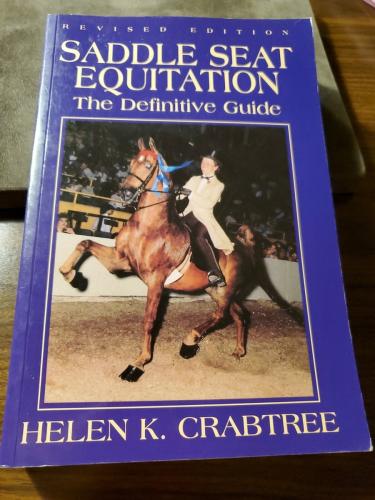
The cover of the famous book Helen Crabtree wrote which continues to serve riders today.
The success of the Crabtrees was immense. They produced 75 world champion American Saddlebreds plus 22 National Equitation champions. Helen wrote Saddle Seat Equitation in 1970, which over a half-century later, still features prominently among those whose careers revolve around the American Saddlebred.
Helen passed away in January 2002 at the age of 86, but the efforts made by her and Charles during their heyday are still felt today. When she passed, Bob Funkhauser wrote, “Shelby County is certainly a place that has grown and embraced the American Saddlebred to the point it is the Saddle Horse capitol and that is a direct result of the Crabtrees moving here from Rock Creek in 1958.”
Fast forward to today, and there are over 90 farms in ShelbyKY dedicated to caring for American Saddlebreds. One of those is Kismet Farm, which is adjacent to the farm the Crabtrees managed. Kismet is among the farms where you can schedule time to fully immerse yourself in the breed’s capital.
Between the impact of the Crabtrees and today’s widespread activity for the breed across ShelbyKY, it’s clear why Funkhauser came to the opinion he did… and why thousands of others view our land as the Saddlebred Capital of the World.
When you’re ready to experience it for yourself, you can plan your trip to ShelbyKY with our visitor guide. It's free and contains wonderful information about how to spend your time in ShelbyKY, whether you’re on horse farms or elsewhere.